- Home
- People + Places
- God’s Battle Axe – Dietric ...


Dietrich Bonhoeffer is one of the heroes of the resistance against the Nazi-inspired regime in Germany headed by Adolf Hitler. His weapons were not however carnal, but mighty through God to the pulling down of the strongholds of satan and his minions in Germany and neighbouring European nations, for he was a man yielded to the leadership of the Holy Spirit.
Bonhoeffer was born on February 4, 1906, in Breslau (now Wroclaw, Poland), to a cultured, upper-class German family. His father, Karl, was the leading neurologist and professor of psychiatry at the University of Berlin. His mother, Paula, was the granddaughter of Karl von Hase, a 19th century church historian.
As liberal Germans and only nominally religious, the Bonhoeffer’s encouraged their eight children, including Dietrich and his twin sister, Sabine, to pursue literature, arts, and higher education. Young Dietrich, a talented pianist, was expected to follow a career in music. But at age 14, much to his family’s dismay, he announced his desire to become a minister of the church.
In the family tradition, Bonhoeffer studied first at Tubingen University, where he began his theological education. He went on to study at the University of Berlin, where he earned his doctor’s degree in theology in 1927. By age 24, he qualified for a teaching appointment at the University of Berlin. However, in 1930, he decided to take a year in the United States to do post-graduate work at New York’s Union Theological Seminary.
While there, his study of Christian ethics exposed him into the real world of human existence. As he encountered new experiences, forged influential friendships, and sat under the teachings of Reinhold Niebuhr, Professor of Applied Christianity at the Seminary, his sensitivity to social problems deepened. He also developed an intense passion for the teachings of Christ in the Sermon on the Mount.

The time in America was a turning point for Bonhoeffer, dramatically deepening his faith and strengthening his determination to oppose Nazi oppression in Germany. When he returned to the country in 1931, he took up a post as a lecturer at the University of Berlin.
It is instructive to note that during the years he was gaining his theological education, Hitler was rising to power in Germany. Many Germans saw the charismatic political leader as a saviour to their nation, which was suffering under extreme economic depression after its defeat in World War I.
By the time Hitler became Chancellor of the country, Bonhoeffer had joined the tanks of theologian Karl Barth and Pastor Martin Niemoller in opposing the Nazi’s anti-Semitic rhetoric and actions. Along with other Christian leaders, they founded the alliance called the Confessing Church, which issued its famous Barmen Declaration in 1934. The declaration put forth a biblical challenge to Nazi ideology and called German Christians to return to the doctrines of the Reformation and the Gospel of Jesus Christ.
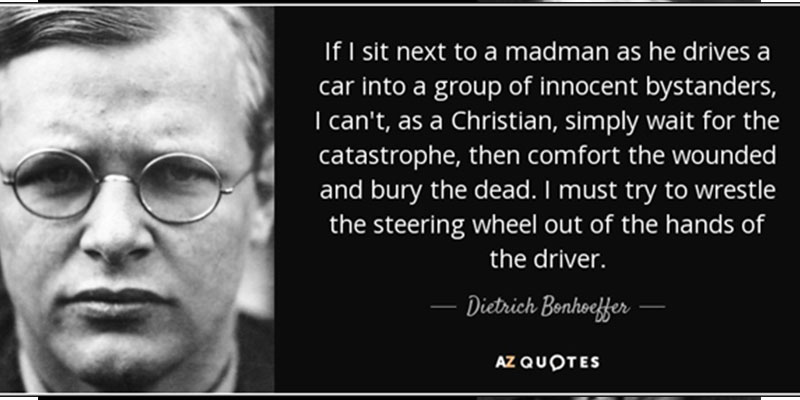
After a two-year stint serving as a chaplain to a Lutheran congregation in London. Bonhoeffer returned to Germany to establish an underground seminary for the Confessing Church at Finkenwalde. During this period, he also wrote copiously about the Christian life, including his most famous work, The Cost of Discipleship, published in 1937. Drawing from Jesus’ Sermon on the Mount teachings, the book warns believers against “cheap grace”, the idea of allowing oneself to become too comfortable as a disciple of Christ. Bonhoeffer’s “costly grace” calls them to faithful and radical obedience to Jesus’ commands. He observed, that “Cheap grace is the preaching of forgiveness without requiring repentance, baptism without church discipline, Communion without confession, absolution without personal confession.” Furthermore, he said that, “Cheap grace is grace without discipleship, grace without the cross, grace without Jesus Christ, living and incarnate.”
In October 1037, the Nazi Gestapo closed Bonhoeffer’s seminary. Consequently, he began to think that he should leave the country to avoid the impending war. In 1939, by invitation of Niebuhr, he went to New York as a guest lecturer, but concern for his country occupied his thoughts. After less than a month in America, he told Niebuhr that he had made a mistake in coming to America and asked for leave to return to Germany to “live through this difficult period in our national history with the Christian people of Germany. I will have no right to participate in the reconstruction of Christian life in Germany after the war if I do not share the trials of this time with my people.”
Bonhoeffer believed that God had called him back to Germany. When he arrived in Berlin, the Nazi government forbade him from publishing any material, teaching or preaching the Gospel. Needing to adapt his strategy of resistance, he joined the German Secret Service (the Abwehr) as a double agent on behalf of the resistance. He began travelling to church conferences around Europe under the guise of gathering information for German military intelligence. This gave him the opportunity to join forces with those who were secretly conspiring to overthrow Hitler. He also used his position to help many Jews to escape from Germany.

In April 1943, the Nazis arrested Bonhoeffer for smuggling Jews from Germany into Switzerland. They subsequently imprisoned him at Tegel. At that time he had become engaged to Maria Von Wedemeyer, a German Mathematician, but they never had a chance to be married. The last two years of Bonhoeffer’s life were spent behind bars, where he pastored fellow inmates and wrote several letters to family and friends. These writings were edited and publishes as Letters and Papers from Prison in 1953 by Eberhard Bethge, Bonhoeffer’s closest friend and primary biographer.
Eventually, the Nazis moved Bonhoeffer to Buchenwald and then to the extermination camp at Flossenburg. On April 9, 1945, less than one month before Germany surrendered to allied forces, he was executed by hanging with six other resistance opposition figures. Sealed by martyrdom at age 39, Bonhoeffer was a modern day hero of the faith. He lived his convictions courageously, inspiring countless believers in Jesus Christ to commit themselves to authentic personal discipleship. His widely read classics and theological writings continue to make him one of the most thought-provoking voices in the contemporary church.
***** Material sourced from Biography of Dietrich Bonhoeffer, German Theologian and Martyr, https://www.learnreligions.com