- Home
- People + Places
- God’s Battle Axe – Johann ...

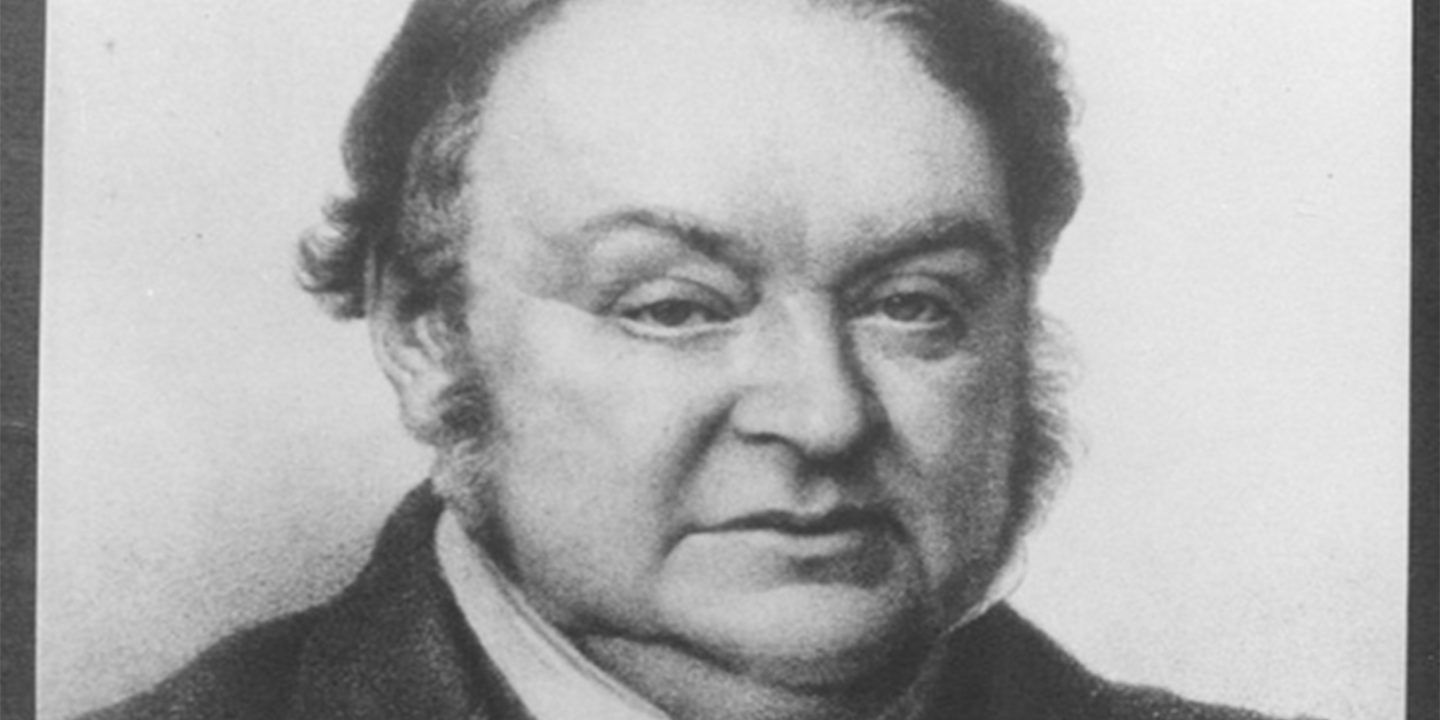
Johann Christoph Blumhardt was a Lutheran pastor and a key figure of the German Pietism. Early in life, it was clear to him that his lifetime was to be used by God.
He was born on July 16, 1805 in Stuttgart. His family was poor but teachers found him to be a gifted child and they encouraged his father to send him on to higher education. Blumhardt loved music and often sang hymns in his home and at church. At the age of 15, he passed the examination to study theology and gained scholarship to Schonthal monastery.
This was a time of intense learning and the development of deep relationships. While he was at school, his father died and as the oldest, he was expected to support the family. He saved as much as he could to help his mother.
Blumhardt then moved to the University of Tubingen where he studied from 1824 to 1829. He continued to deepen his relationship with God. He studied the Bible and writings of reformation leaders such as Martin Luther.
After graduation, his first assignment was in Durrmenz-Muhlacker. The parish was large having 2,500 members. He was hired as a curate and gladly embraced his pastoral role. He made an effort to spend time with parishioners and was well-loved. Blumhardt learned to preach and grew in the basics of being a pastor and a theologian.
His next step was to be taken on at the Basel Mission Institute under his uncle in 1830. Basel was on the cutting edge of Christianity at that time. They held conferences and shared the topics that were affecting the church worldwide. Blumhardt remained at the institute for six and one-half years. He described it as having people from all over world in constant attendance.
There was an intense focus on missions, both locally and internationally. His specialty was Hebrew, but he often encouraged his students to step out in the things of God. Blumhardt also filled in preaching in the local area as needed and even taught youth classes. During this time, he met and became engaged to Doris Kollner.
In the spring of 1837, Blumhardt took a parish in Iptengen. He was an assistant to a pastor who had alienated his parishioners. The area also had a large “separatist group” that was rigidly religious and anti-protestant. He worked hard to reconcile the parishioners and to treat them with more respect than they had been receiving.
He even made inroads into the separatist camp and they began to attend his services. Thereafter, he began seeking positions where he could be head pastor and have his own home. He could not marry until that was accomplished.
A dear friend of his, Pastor Barth, was going to retire and he wanted him to take his position in the small town of Mottlingento as the area pastor. Finally, in June 1838, Blumhardt took the position. He married and began to establish his own family and pastoral relationships. In the spring of 1840, a family by the name of Dittus, consisting of two brother and three sisters, moved into the village. The youngest was Gottliebin, a girl who struggled with one illness after another.
She regularly attended services held by Blumhardt, but struggled with bizarre reactions to his presence. She became increasingly tormented by sounds, lights, and a sense of physical presences around her. Late in 1841, Blumhardt prayed for her. She did not get better, but in fact got worse. Finally, she came under such an attack that they thought she was going to die.
Blumhardt and his close friends began to cry out to God for wisdom to save this young woman. They searched the scripture for direction and guidance. One day, as he visited the girl, it became clear to him that something demonic was at work, and he was upset that nothing seemed like he could help her.
Finally, he cried out “Gottliebin, put your hands together and pray, ‘Lord Jesus, help me!’ We have seen enough of what the devil can do; now let us see what the Lord Jesus can do!” The attack she was under stopped and she sat up and repeated his prayer.
Now Blumhardt understood that this was a battle that had to be won. Gottliebin improved for only a short time, but then went back to convulsions. Over the next year, there were series of prayer meetings, where there seemed some improvement, and then a return to torment for the young girl. Finally, one night, the battle came to a fever pitch and she and her family were delivered. She improved from that time on and attained complete health. All her former ailments, well known to her physicians, completely disappeared – the high shoulder, the short leg, stomach troubles and others.
With that dark and difficult chapter closed, there came the opening of a new even more significant one: a widespread movement of repentance and renewal that changed hundreds of lives and spread far beyond the town. People began coming to Blumhardt, and writing him letters, confessing their sins. This began with the youth group, and then moved to the adults of the village.
He wrote that people came from seven o’clock in the morning until eleven o’clock at night. Prayer meetings were going on every night, and people from other villages began to come to confess their sins. Within months, hundreds of people had come to Blumhardt and his churchyard was full to overflowing. He called this the “Awakening.”
One of the important lessons that Blumhardt learned was that when people confessed their sins, it was important for him to speak out forgiveness to them. He would see a weight lift off them as he laid his hands on them, and spoke forgiveness. He saw how sin would grip people when it operated in secrecy, but vanished when exposed to the light.
Blumhardt believed salvation was not something that should be walked in alone. Rather, he believed it was important that it be walked in openness with others. Many times people would be healed in his meetings when they confessed their sins and were forgiven. Everywhere people were under conviction. Disagreements were settled, stolen goods returned, alcoholics released etc.
Miracles and healings began to occur. One day, a mother came running to Blumhardt because she had spilled a pot of boiling oatmeal on her three year old child. They ran to the house, where many were gathered. The child was screaming in pain, and covered with burns. Blumhardt picked up the toddler and prayed.
All pain immediately ceased and the burns were gone within days. Parents from another village came to the pastor because their son had an eye disease, and a doctor said his only hope was surgery. Blumhardt prayed and his sight was fully restored within three days. People began flowing in from all over to receive prayer for their sicknesses.
Infirmities of all kinds vanished: eye problems, tuberculosis, eczema, arthritis, and more. A person who was there at the time later said, “There were so many miracles that I can no longer recall the details. We felt the Lord’s nearness so tangibly that they seemed natural, and no one made a great deal of it.”
The government and organised church looked upon this latest development with disfavour and disgust. At the beginning of 1846, the government and his superiors would not allow him to include healing as part of his pastoral duty. They wanted him to direct sick people to medical doctors. In his response, Blumhardt asked people to come to the church, listen to the sermon, and put their needs before Jesus.
His heart was broken, as people tried to reach him with their needs, and he could not pray with them. Finally, when he was told that not only could he not pray for people, but also he could not give hope out of scriptures, he felt he could no longer obey. He saw that apathy was once again taking hold of his parish and the Awakening was being lost. He was not antagonistic to medical help; he just believed that prayer could touch cases that seemed incurable to physicians.
Eventually, Blumhardt decided to leave Mottlingen. He purchased a run-sown sulphur springs spa in Bad Boll. Here he as considered a pastor of a special parish, and all limitations were lifted from him. People began to flock to Bad Boll for healing and ministry. He would have as many as 150 people staying there at a time.
People were regularly healed at Bad Boll, but Blumhardt asked that these healings should not be the focal point of the ministry. He wanted all of God’s gifts to be honoured there. He died on February 25, 1880, at age 69. His ministry in healing and deliverance made the way for many to follow. He is respected as a forerunner of the Divine Healing Movement, which would take his writings and teachings and carry on the revelations he received. His son, Christoph Blumhardt continued his ministry at Bad Boll after his death.
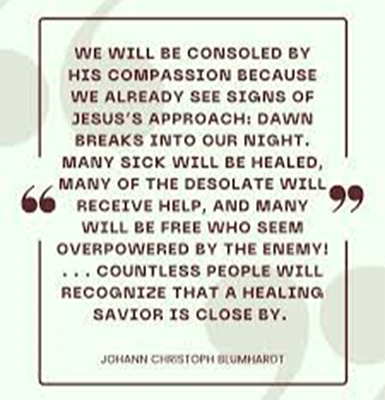
It takes courage for a man to resist the intimidation of institutional churches opposed to operations of the Holy Spirit. These churches, which boast of their so-called orthodoxy, were even more influential during Blumhardt’s days than in our generation. They promote Cessationism, the idea that the Holy Spirit stopped working visibly in the church after the compilation of the Bible. Obviously, they have no Scriptural basis for their heretical doctrines.
Thank God for His battle axes like Blumhardt that have called their bluff all through the ages and proclaimed the saving power of the Gospel, with signs and wonders following. It is our responsibility to resist the enemy through whichever channels he operates, including the government and fake churches. God expects us to bow to none other than Him and His eternal Word.
****** Some materials sourced from “Deliverance Leads to Healing and Revival”, https://www.healingandrevival.com/BioJBlumhardt.html